Start with what the water gives
“Local catch” is not a fixed menu. What is landed depends on fishing grounds, weather, gear, season, regulation and the work of handling seafood safely. A harbour town may have a varied fishing history while its present-day supply reaches shops and kitchens through a wider network. Ask what is in season and where it comes from; those questions are more useful than assuming every waterfront restaurant serves fish landed on the nearest quay.
Shellfish traditions give many coastal regions a distinct culinary accent. Cornwall is strongly associated with crab and lobster fisheries, while Scotland has longstanding seafood traditions that include langoustines, mussels and oysters. The species available and the way they are sold vary, so regional identity should be a starting point for curiosity, not a promise about a particular dish or business.
Markets and the movement of fish
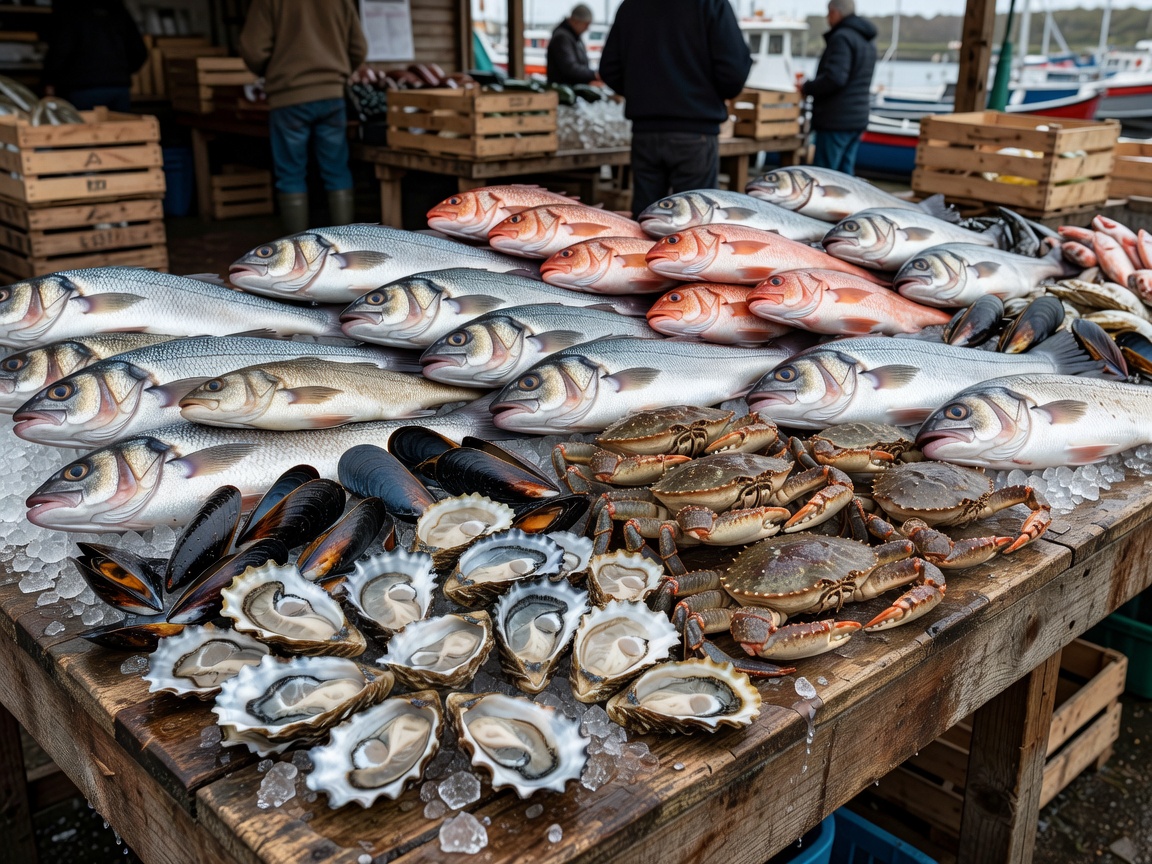
A fish market can make the route from sea to kitchen visible. Some markets serve trade customers, some include public-facing counters and others operate within working premises that are not open as attractions. Billingsgate Market in London is a major wholesale fish market, far from the coast but part of the wider network through which seafood moves. Along the coast, market streets and fishmongers may provide a more immediate view of local buying habits, though opening hours and access should always be checked directly.
Markets are more than displays. Temperature control, sorting, grading, cleaning and careful packing are part of seafood’s journey. Their practical language can explain why freshness is connected to handling and time, not simply to a picturesque point of origin. In a harbour district, shops and food stalls may sit beside working infrastructure; visitors should respect access boundaries and avoid disrupting trade.
Preserving flavour, shaping tradition
Smoking and curing extend seafood’s keeping qualities and create flavours that belong to particular places and craft histories. Kippers are closely associated with the North East of England, especially the town of Craster, where herring smoking is an established regional tradition. Across Britain, smoked haddock, cured salmon and other preserved fish appear in different culinary contexts. These methods are not interchangeable: wood, salt, time and the kind of fish all affect the result.
Preparation also reflects local practice and available ingredients. A simple grilled fish, a shellfish broth, a pie or a smoked-fish dish may express a different relationship between catch and kitchen. Cornish fishing heritage and Scottish coastal cooking are varied rather than singular; landscapes, communities and changing supply produce many interpretations. It is sensible to follow local descriptions while avoiding the assumption that a dish is universal across an entire region.
What a stay can reveal
Accommodation can make food culture easier to encounter through location: a short walk to a fishmonger, a market district or a harbour-side dining area may offer a more grounded view than a room with a sea view alone. Some stays have a dining space; others are better understood as a convenient base for independent exploration. Do not infer menus, sourcing policies or facilities from a hotel’s setting. Check current details with the provider and look for clear information on dietary needs and accessibility.
Seasonality shapes both what is available and the mood of a coastal town. Fishing activity varies with species and conditions, while visitor patterns influence when kitchens and shops are busiest. A shoulder-season visit may feel quieter, but the choice of open businesses can differ. A useful question is not “What seafood will always be there?” but “How does this place talk about its catch, its suppliers and its seasons?”
Eat with attention
Look for specific descriptions that name species, source or preparation rather than leaning on vague claims of freshness. Ask how a business describes its supply, and be open to alternatives when a particular catch is unavailable. Responsible curiosity respects the realities of fisheries and the people who work in them; it does not treat a market or quay as a stage set. The strongest food memories often begin with context: a regional method, a changing season, a working street and the understanding that coastal food is part of a living economy.